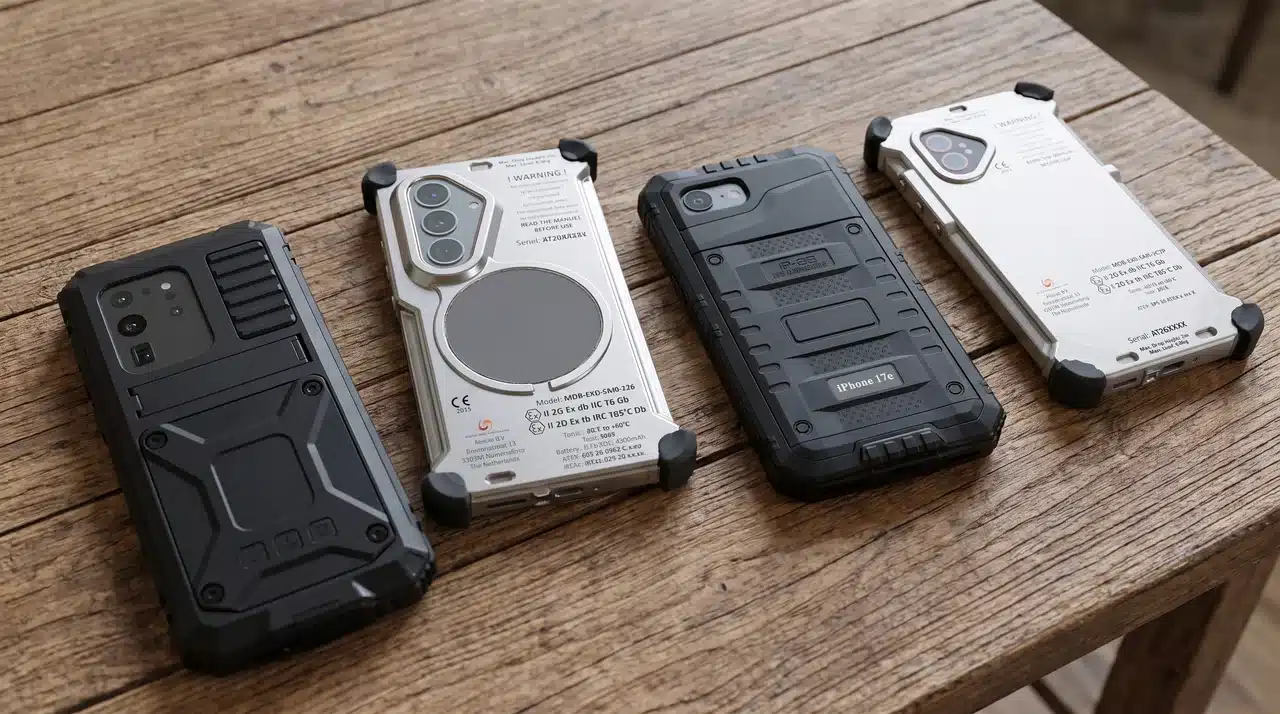



If you manage operations in oil and gas, chemical processing, offshore energy, or mining, you encounter three major certification acronyms almost daily: ATEX, IECEx, and NEC. These abbreviations are stamped on safety labels, procurement manifests, and the chassis of every mobile device entering your facility.
However, assuming that these frameworks are interchangeable is a dangerous mistake. Confusing them can introduce severe compliance gaps and catastrophic ignition hazards into your plant.
At Atexxo Manufacturing, we engineer explosion-proof enclosures for the world’s leading smart devices, allowing them to operate safely across these diverse global standards. To help you navigate the complex web of electrical safety, here is a clear breakdown of how ATEX, IECEx, and NEC compare, and why getting it right is non-negotiable for your mobile fleet.
ATEX: the mandatory European framework
Derived from the French term ATmosphères EXplosibles, ATEX represents two mandatory European Union directives that regulate explosion protection across the European Economic Area (EEA) and the UK (via DSEAR).
- ATEX 114 (equipment directive): This focuses on the manufacturer. It mandates the strict safety standards and testing protocols that equipment (like an Atexxo explosion-proof iPhone case) must pass before it can be legally sold in the EU. It evaluates all ignition vectors, including electrical sparks and thermal surface heat.
- ATEX 137 (workplace directive): This places the legal burden on the facility operator. Employers must formally assess their plant risks, classify hazardous areas into numerical zones (such as Zone 1 or Zone 2), and ensure that their field crews are only equipped with devices certified specifically for those zones.
IECEx: the harmonized international standard
While ATEX is a legally enforced directive within Europe, IECEx (International Electrotechnical Commission Explosive) is a voluntary global certification scheme. Its primary goal is to facilitate international trade by creating a single, harmonized standard.
By relying on a unified set of testing protocols, IECEx allows manufacturers to certify their hardware once and deploy it across multiple global markets without having to pay for redundant re-testing in every single country.
- Global adoption: Countries like Australia mandate IECEx as their primary safety baseline, while many operators in the Middle East and Asia use it alongside their national approvals.
- Transparent verification: IECEx maintains a publicly accessible online database where safety managers can instantly verify active equipment certificates.
- Streamlined procurement: By choosing Atexxo devices that carry dual ATEX and IECEx certification, multinational firms can standardize on a single mobile hardware solution globally.
NEC and CEC: the North American approach
North America utilizes a completely different regulatory framework: the National Electrical Code (NEC) in the United States and the Canadian Electrical Code (CEC) in Canada.
Historically, North America categorized hazardous environments using a Class and Division structure, rather than the Zone system used by ATEX and IECEx.
- Classes: These define the type of hazard. Class I covers flammable gases and vapors, Class II covers combustible dusts, and Class III covers ignitable fibers.
- Divisions: These define the likelihood of the hazard. Division 1 indicates the hazard is expected during normal daily operations. Division 2 indicates the hazard is only present under abnormal breakdown or fault conditions.
Crucial warning: Simply having an ATEX or IECEx certificate is not enough to deploy a device on a US site. Hardware must carry an explicit listing from a Nationally Recognized Testing Laboratory (NRTL), such as UL or CSA, verifying compliance with NEC standards.
To help visualize how these different systems overlap, explore our interactive comparison tool:
Mapping the standards: how class/division translates to zones
To bridge the gap between international trade and local compliance, recent updates to the NEC (Articles 505 and 506) allow US operators to apply European-style Zone classifications as an alternative to the traditional Class/Division rules.
While the systems are not identical, safety standards provide a general equivalence mapping:
- Class I, Division 1 (gas) is generally equivalent to Zone 0 or Zone 1 (hazards present continuously or occasionally).
- Class I, Division 2 (gas) is generally equivalent to Zone 2 (hazards present only during rare equipment failures).
- Class II, Division 1 (dust) aligns with Zone 20 or Zone 21.
- Class II, Division 2 (dust) aligns with Zone 22.
Why hardware certification matters for mobile technology
Modern enterprise smartphones are incredibly powerful digital tools, running real-time inspection apps, dynamic permit-to-work systems, and augmented reality guidance. However, bringing an uncertified consumer smartphone into a Zone 1 or Division 1 hazardous area introduces a massive ignition risk.
High-capacity lithium batteries can generate thermal runaway during a fault, while unshielded microprocessors can easily exceed the auto-ignition temperatures of surrounding process gases.
By deploying flagship hardware—such as the iPhone 17 Pro Max—safely enclosed within an Atexxo ATEX/IECEx Zone 1 certified enclosure, you ensure absolute regulatory compliance. It allows your field crews to utilize modern iOS applications safely while seamlessly satisfying safety audits across Europe, international waters, and global facilities.
Frequently asked questions
Can an ATEX certified smartphone be used legally in the United States?
Not automatically. In the US, OSHA regulations dictate that equipment deployed in classified hazardous locations must carry an explicit listing from a Nationally Recognized Testing Laboratory (such as UL or CSA) to verify compliance with NEC standards. An ATEX certificate alone is insufficient unless explicitly approved by the site’s local Authority Having Jurisdiction (AHJ).
What is the primary operational difference between Division 1 and Zone 1?
Under the North American system, Division 1 lumps both continuous hazards (Zone 0) and occasional hazards (Zone 1) into a single broad classification. The international Zone 1 specifically defines environments where explosive atmospheres occur occasionally during normal operations (between 10 to 1,000 hours per year).
Why do manufacturers build devices with dual ATEX and IECEx certification?
Dual certification allows enterprise procurement teams to purchase a single mobile device model that is legally compliant for deployment across European facilities (under mandatory ATEX law) and international sites in Australia, Asia, and the Middle East (under the IECEx scheme). This drastically reduces fleet management complexity and training overhead.