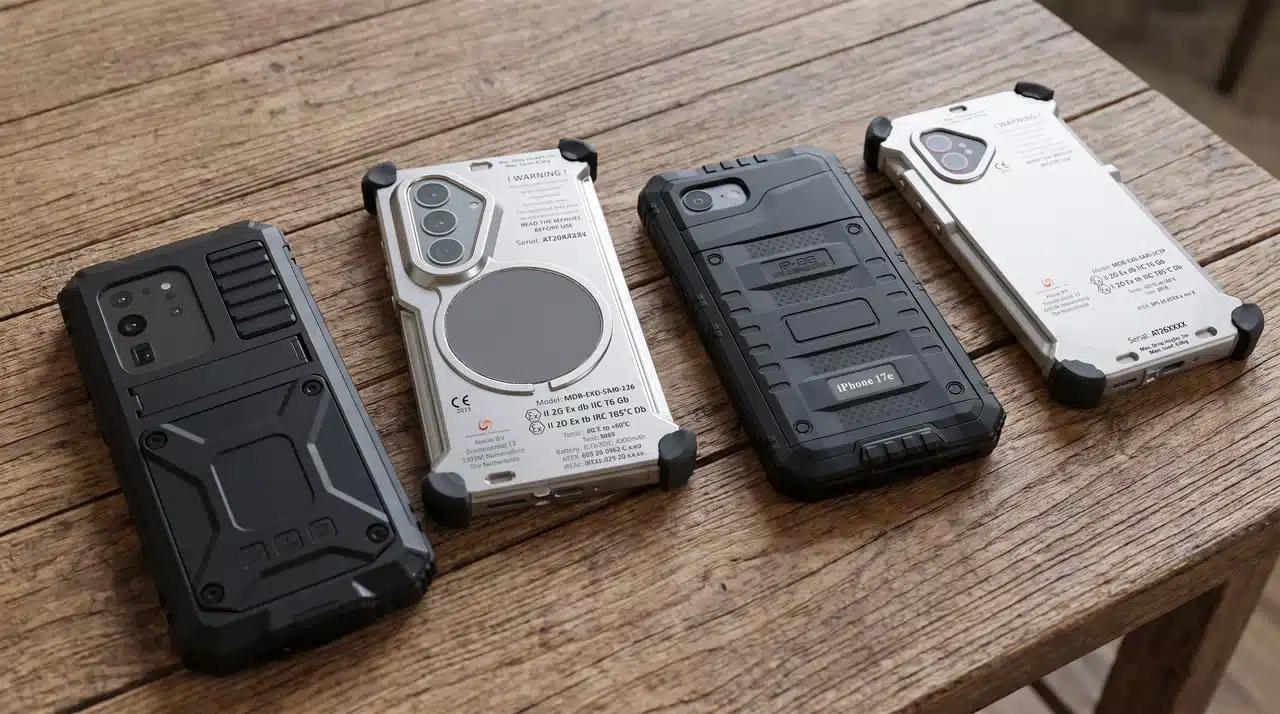


Every ATEX or IECEx certified smartphone features a dense string of numbers, letters, and symbols printed on its chassis. To the untrained eye, it looks like a random serial code or manufacturing jargon. Because of this, many facility managers simply look for the word “certified” and assume the device is safe for their specific plant.
This assumption can be incredibly dangerous.
An ATEX marking is not just a stamp of approval; it is a highly specific technical summary that dictates exactly where a device can and cannot operate safely. Two smartphones can both be legally certified, yet one might trigger an explosion if brought into the wrong chemical zone.
At Atexxo Manufacturing, we don’t just engineer explosion-proof enclosures—we help facilities understand exactly what protection they are deploying. Here is a step-by-step guide to decoding these critical safety labels.
Breaking down the certification string
Let’s look at a standard Zone 1 certification string you might find on an Atexxo-converted smart device: II 2G Ex ia IIC T4 Gb.
While it looks complicated, it reads logically from left to right, covering the industry type, the hazard zone, the engineering protection method, the chemical groups, and the maximum temperature.
To see exactly how these variables interact, you can use our interactive decoder below to build and translate different ATEX strings:
Defining your equipment group and operating zone
The first part of the string dictates the broad industry and the specific physical zones the device is approved for.
- Equipment group (II): The Roman numeral II indicates the device is built for surface industries like refineries, chemical plants, and offshore rigs. Group I is strictly reserved for underground mining operations where coal dust and methane are present.
- ATEX category (2): This number maps directly to the site zone. Category 1 is for continuous hazards (Zone 0/20). Category 2 is for occasional hazards (Zone 1/21). Category 3 is for rare hazards (Zone 2/22).
- Atmosphere type (G or D): The letter ‘G’ stands for flammable gas, vapor, or mist. The letter ‘D’ stands for combustible dust. If a device is marked ‘2G’, it is certified for Zone 1 gas, but it is explicitly not rated for combustible dust environments.
Understanding protection methods
The next segment, usually starting with ‘Ex’, defines the engineering philosophy used to prevent the device from sparking. For handheld smart devices, the primary method is intrinsic safety (Ex i), which limits electrical energy so sparks physically cannot form.
- Ex ia: The highest protection level. The device remains safe even if two independent internal faults occur simultaneously.
- Ex ib: A high protection level where the device remains safe with one internal fault. This is fully compliant for standard Zone 1 operations.
Navigating gas groups and backward compatibility
Gases vary wildly in how much energy it takes to ignite them. The gas group marking tells you which chemicals the device is safe around.
- Group IIA covers gases like propane.
- Group IIB covers gases like ethylene.
- Group IIC covers highly volatile gases like hydrogen and acetylene.
Group IIC represents the highest hazard level. If you deploy a device rated for IIC, it is completely backward-compatible with IIB and IIA environments. Standardizing on Group IIC hardware is the best way to prevent someone from accidentally carrying the wrong phone into a highly volatile area.
The temperature class misconception
The temperature class (T-class) defines the absolute maximum surface temperature the device can reach under a fault condition. The golden rule is that this surface temperature must remain below the auto-ignition temperature of the surrounding gases.
Here is where the biggest misconception lies: a T1 rating is not safer than a T6 rating.
- A T1 device is legally permitted to reach 450°C—hot enough to instantly ignite most industrial solvents.
- A T6 device is strictly capped at a maximum surface temperature of 85°C.
Therefore, a higher T-number means a lower surface temperature, making it significantly safer. Most Atexxo Zone 1 conversions carry a T4 rating (capped at 135°C), which safely covers the vast majority of standard oil, gas, and chemical processing environments.
A quick verification checklist for your site
Before you procure any explosion-proof mobile device, do not stop at verifying the basic ATEX certificate. Always run through this simple three-step check:
- Cross-reference the zone and category (e.g., ensuring a Zone 1 area gets a category 2 device).
- Match the gas and dust groups against your facility’s specific chemical inventory.
- Verify your thermal margins by ensuring the device’s T-class sits safely below the lowest auto-ignition temperature on your site.
Frequently asked questions
What is the difference between Ex ia and Ex ib protection concepts?
Both are intrinsic safety methods. Ex ia represents the highest tier, engineered to remain completely safe even if two independent electrical faults occur simultaneously. Ex ib is designed to remain safe if a single component fault occurs, which is still fully approved and safe for standard Zone 1 operations.
Why is a T6 temperature class safer than a T1 temperature class?
Temperature classes define the maximum surface heat a device can reach. A T1 device can legally reach up to 450°C. A T6 device is strictly capped at 85°C. Because many volatile gases ignite at lower temperatures, a cooler device (T6) offers much broader protection against accidental ignition.
Can a device marked only with “2G” be used in a combustible dust environment?
No. The ‘G’ explicitly indicates that the hardware was only tested for flammable gases, vapors, and mists. To safely enter a combustible dust area (like a Zone 21 milling facility), the ATEX string must explicitly include a ‘D’ (such as 2D or 2G/2D).