

Industrial safety operates on a highly specific vocabulary. When you are equipping a facility where explosive gases or combustible dusts are present, assuming you know what an acronym or certification label means is a massive risk. A single misinterpretation can lead to the deployment of unsafe equipment, putting both your personnel and your compliance status in jeopardy.
At Atexxo Manufacturing, we regularly consult with safety managers to ensure our explosion-proof smart devices perfectly match their site’s unique risk profile. To help you cut through the confusion and make informed hardware decisions, we have built this definitive cheat sheet for industrial compliance terminology.
The regulatory baseline
Before deploying any mobile device into the field, you must understand the legal and technical frameworks that dictate its design.
- ATEX: This is the mandatory regulatory framework governed by the European Union. It covers the strict manufacturing requirements for equipment (Directive 2014/34/EU) and the workplace safety protocols employers must follow (Directive 1999/92/EC).
- IECEx: An international certification scheme designed to create a unified, global standard for explosion protection. While ATEX is Europe-specific, IECEx makes it easier to verify equipment safety across international borders.
- Notified body: Independent auditing organizations (such as UL, DEKRA, or SGS). These authorities rigorously test equipment and audit manufacturing facilities before issuing the official ATEX or IECEx certificates.
Mapping your hazardous zones
Facilities are divided into distinct zones based on the frequency and duration of an explosive atmosphere. The terminology differs slightly depending on whether you are dealing with gas or dust.
| Hazard frequency | Gas zone | Dust zone | Operational definition |
| Continuous | Zone 0 | Zone 20 | An explosive atmosphere is present constantly or for very long periods (typically >1,000 hours per year). |
| Occasional | Zone 1 | Zone 21 | An explosive atmosphere is likely to form occasionally during normal, daily operations (10 to 1,000 hours per year). |
| Rare | Zone 2 | Zone 22 | An explosive atmosphere is highly unlikely to occur. If it does, it will exist for a very short duration due to a fault or leak. |
Categorizing the fuel: gas and dust groups
Knowing your zone is only half the battle; you must also identify the specific fuel source. Atmospheres are categorized based on the minimum amount of electrical spark energy required to ignite them.
- Group I: Strictly reserved for underground mining operations dealing with methane and coal dust.
- Group II: Surface industries (such as petrochemical, oil, and pharmaceutical facilities). Group II is subdivided by volatility:
- IIA: Lower hazard gases that require more energy to ignite (e.g., propane).
- IIB: Medium hazard gases (e.g., ethylene).
- IIC: The highest hazard gases (e.g., hydrogen and acetylene). Equipment rated for IIC is the safest and is universally backward-compatible with IIA and IIB environments.
- Group III: Combustible dusts. This ranges from combustible flyings like lint (IIIA) to highly dangerous, electrically conductive dusts like metal powders (IIIC).
The temperature class (T-class) scale
Electronic devices naturally generate heat. If a device’s surface gets too hot, it can ignite the surrounding atmosphere without ever producing a spark. The T-class indicates the absolute maximum surface temperature a device is allowed to reach.
Counterintuitively, a higher T-class number means a cooler, safer device.
- T1: The device can reach up to 450°C (safe only for gases with very high ignition points, like methane).
- T4: The device is strictly capped at 135°C. This is the sweet spot for Atexxo’s converted smartphones, providing a safe operating margin for the vast majority of industrial chemicals.
- T6: The device is capped at 85°C. This is the strictest limit, required only for highly sensitive environments handling chemicals like carbon disulfide.
Engineering protection concepts
Manufacturers use different engineering philosophies to stop a device from causing an explosion. These are known as protection concepts or Ex codes.
- Intrinsic safety (Ex i): A preventive approach. The internal circuitry is engineered to limit electrical current and thermal energy to levels so low that a spark physically cannot form. ‘Ex ia’ means the device stays safe even with two simultaneous internal faults, while ‘Ex ib’ is safe with one fault.
- Explosion-proof / flameproof (Ex d): A containment approach. The device sits inside a heavy-duty enclosure designed to withstand an internal blast. If a spark ignites gas inside the casing, the enclosure cools the escaping flames so they cannot ignite the outside atmosphere.
Reading the certification string
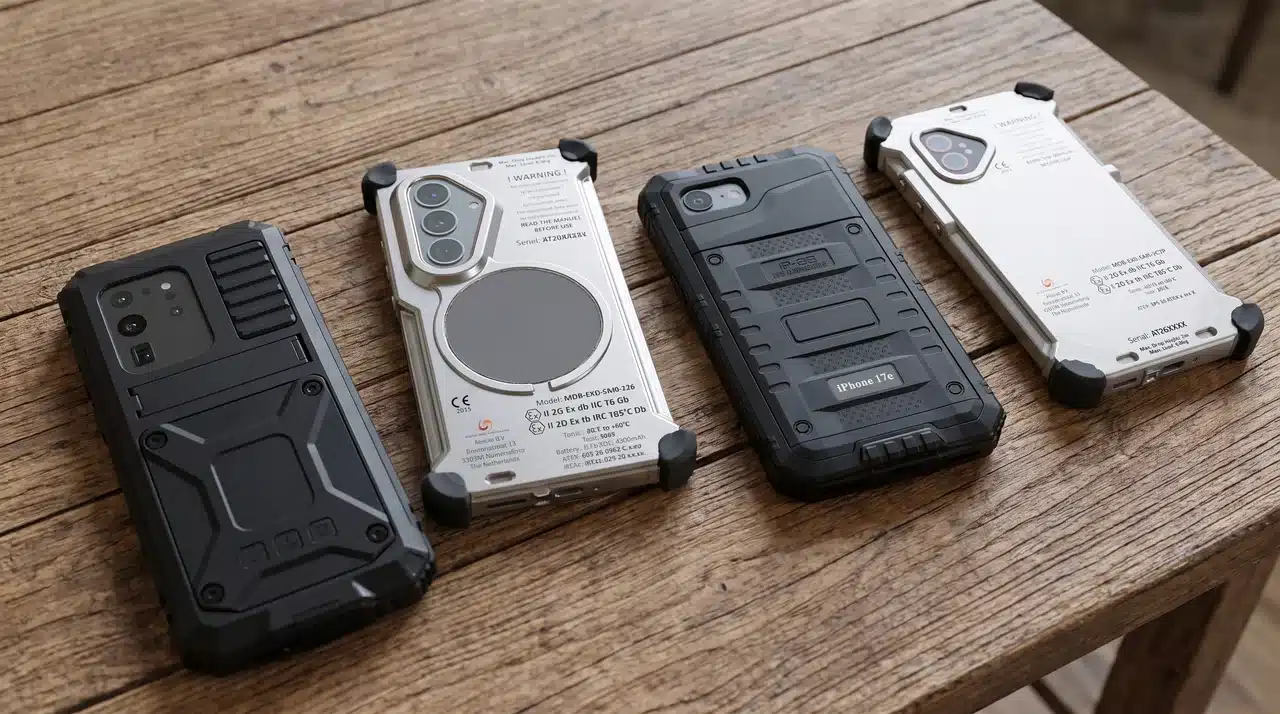
When you inspect an Atexxo-modified smart device, you will see a detailed string like: CE 0539 Ex II 2 G Ex ib IIC T4 Gb. Here is exactly what that means:
- CE 0539 & Ex: Confirms European conformity, the testing body’s ID number, and the official explosion protection logo.
- II 2 G: The device is built for surface industries (II), Zone 1 environments (2), containing flammable gas (G).
- Ex ib: It is protected via intrinsic safety with one-fault tolerance.
- IIC: It is safe to use around the most volatile gases, like hydrogen.
- T4: Its surface temperature will never exceed 135°C.
- Gb: The IECEx code confirming high protection for gas environments.
Beware the ruggedized myth
A common and dangerous mistake is purchasing a “rugged” consumer phone and assuming it is safe for a refinery. Rugged specifications (like IP68 for water ingress or MIL-STD-810H for drop protection) only indicate physical durability. They offer absolutely no protection against electrical or thermal ignition.
To safely operate modern enterprise software in a Zone 1 or Zone 2 area, you need true, certified explosion-proof enclosures. At Atexxo Manufacturing, we bridge this gap by safely housing the world’s most advanced flagship devices—like the iPhone 17 Pro Max—within fully compliant ATEX enclosures, giving you commercial performance without the safety risk.
Frequently asked questions
What is the core difference between ATEX and IECEx?
ATEX is a mandatory regulatory framework required by law for any hazardous area equipment sold or operated within the European Union. IECEx is an international, voluntary certification scheme that aims to harmonize these technical standards globally, making it easier for facilities in Asia, the Middle East, and the Americas to verify equipment safety.
Why is a T4 temperature class the standard for mobile devices?
A T4 rating ensures the device’s surface temperature will never exceed 135°C. This specific temperature ceiling provides a highly reliable safety margin, as it sits comfortably below the auto-ignition points of the most common industrial fuels and solvents, including diesel, ethanol, and petrol.
Is a rugged industrial tablet automatically safe for ATEX zones?
No. Ruggedized ratings only measure a device’s ability to survive physical abuse, such as drops, shocks, and water submersion. They provide zero certification for electrical energy limitation. To legally and safely enter a classified hazardous area, the device must carry explicit ATEX or IECEx safety markings.
Which specific hazardous zones and chemical groups does your facility struggle to source compatible mobile hardware for the most?