

While an ATEX or IECEx zone classification defines where a mobile device can legally operate, the Ex protection code explains how the device physically prevents an explosion. Understanding these underlying engineering philosophies allows safety officers and procurement teams to select hardware tailored specifically to their facility’s physical risks.
At Atexxo Manufacturing, we specialize in converting the world’s most advanced mobile hardware into fully certified explosion-proof equipment. Here is a breakdown of the primary Ex protection methods, how they work, and how they combine to create safe industrial devices.
Prevention versus containment: Ex i and Ex d
The two most prominent philosophies in hazardous area mobility are prevention and containment.
- Ex i (intrinsic safety): A preventive strategy. The internal electrical circuitry is designed to strictly cap current, voltage, and thermal energy. This ensures that even under fault conditions, electrical sparks or surface heat physically cannot reach the minimum ignition energy (MIE) of surrounding gases. Intrinsic safety is subdivided into Ex ia (safe with two simultaneous component faults, required for Zone 0), Ex ib (safe with one fault, standard for Zone 1), and Ex ic (safe during normal operation, used for Zone 2).
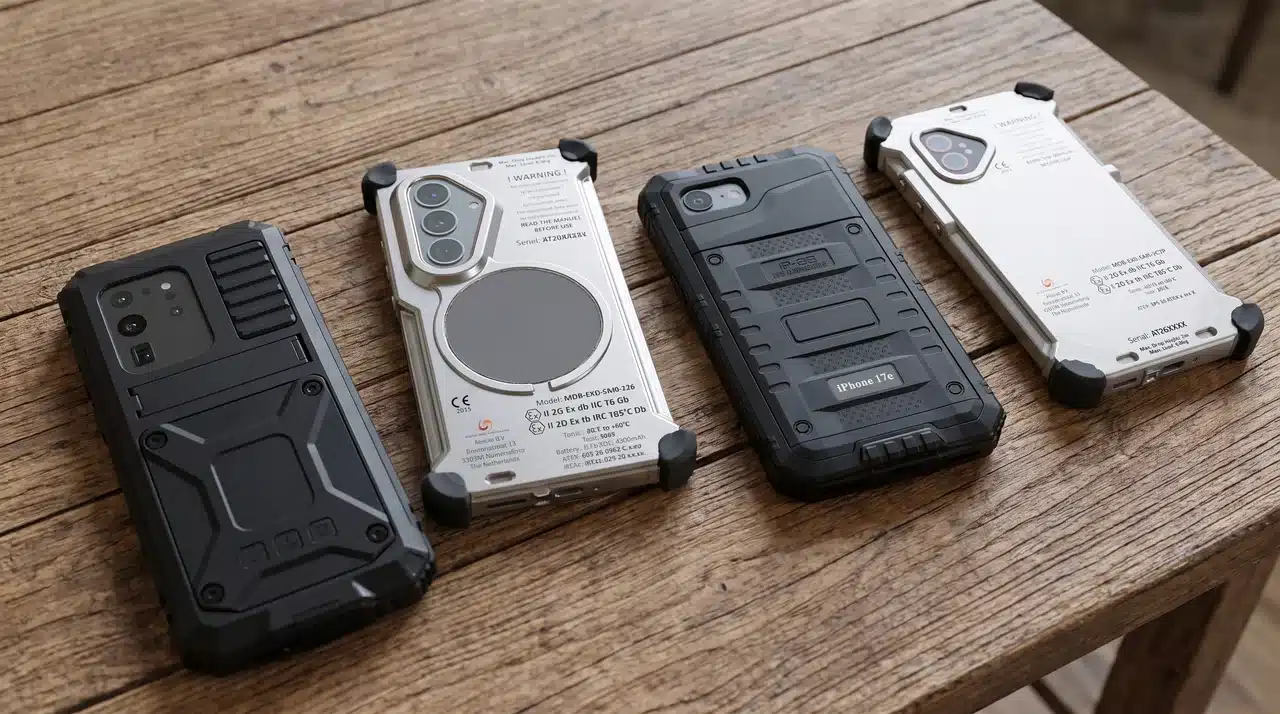
- Ex d (flameproof / explosion-proof): A containment strategy. Ex d engineering accepts that an internal spark or battery failure could occur inside the housing. Safety is provided by a heavy-duty, pressure-resistant outer enclosure. If an internal ignition happens, expanding hot gases are forced through precision-machined channels known as flame paths. These narrow pathways rapidly cool the escaping gas below the auto-ignition temperature of the outside air. At Atexxo Manufacturing, we utilize precision Ex d enclosure engineering to bring flagship consumer devices—like the latest Apple iPhones—safely into Zone 1 and Zone 2 environments without throttling their processing power.
Component isolation and arc elimination: Ex m and Ex e
Beyond primary circuitry and external housings, specialized protection methods are applied to specific internal components:
- Ex m (encapsulation): Isolates high-risk components by completely surrounding them in a solid, non-conductive resin (a process known as potting). Because volatile gases cannot physically reach the electrical components, ignition is impossible. In mobile electronics, Ex m is routinely applied to high-energy lithium-ion battery packs and wireless charging modules.
- Ex e (increased safety): Prevents arcs, sparks, and excessive surface heat during normal operations by increasing the physical distance between conductive elements (maintaining strict creepage and clearance metrics) and using high-grade insulating materials. On certified smartphones, Ex e principles are frequently applied to external charging terminals, switches, and high-current connectors.
Physical exclusion: Ex t for dust hazards
Gases and combustible dusts present entirely different physical threats. While gas protection focuses on energy caps and flame containment, dust protection (Ex t) relies on physical exclusion.
Fine conductive particles (such as aluminum, graphite, or grain dust) can short-circuit micro-electronics if allowed inside the casing. Ex t protection requires dust-tight sealing, directly tied to an IP6X ingress protection rating (typically IP68 for complete submersion and dust isolation).
To explore how these protection concepts map to specific plant hazards and device components, use our interactive tool below:
Combining protection concepts in modern mobile hardware
High-performance industrial smartphones rarely rely on a single protection method. Instead, engineers combine multiple Ex techniques across different hardware components to deliver full-shift functionality while satisfying strict ATEX and IECEx standards.
For example, a modern Atexxo-converted smart terminal might carry a combined certification string like Ex ib mb IIC T4 Gb / Ex tb IIIC T135°C Db:
| Device component | Protection standard | Engineering mechanism |
| Logic board & display drivers | Ex ib (Intrinsic safety) | Energy-limited circuitry preventing sparks |
| Lithium battery module | Ex mb (Encapsulation) | Solid resin potting isolating chemical energy |
| Outer housing & seals | Ex d / Ex tb (Flameproof & dust protection) | Blast-containment housing with IP68 dust-tight gaskets |
By matching each component with its optimal protection concept, Atexxo delivers sleek, full-featured mobile terminals capable of operating safely across Zone 1, Zone 2, Zone 21, and Zone 22 environments.
Frequently asked questions
What is the main practical difference between Ex i (intrinsic safety) and Ex d (flameproof)?
Ex i prevents explosions by capping electrical and thermal energy so sparks physically cannot form. Ex d accepts that an internal spark might occur, using a heavy-duty enclosure to contain the blast and cool escaping gases so they cannot ignite the outside atmosphere.
Why are modern flagship smartphones rarely certified as Ex ia for Zone 0?
An Ex ia rating requires hardware to remain safe even under two independent internal faults. Flagship smartphones require significant power to drive high-speed multi-core processors, bright displays, and advanced cameras, making it virtually impossible to cap electrical energy to Ex ia levels without crippling device performance. Consequently, Zone 1 (Ex ib or Ex d) is the operational baseline for high-performance industrial smart devices.
Is a gas protection rating (Ex i or Ex d) sufficient for combustible dust zones?
No. Gas protection concepts evaluate flammable vapors. To operate legally in combustible dust environments (Zone 21 or Zone 22), the hardware must explicitly carry a dust protection rating (such as Ex t or Ex tb) alongside a certified dust-tight ingress rating (IP6X).