

The current wave of artificial intelligence promises to revolutionize industrial maintenance, but it harbors a fatal flaw for field workers: a crippling addiction to the cloud.
Most AI applications require a technician to capture an image, send it to a remote server, wait for the algorithm to process the data, and then receive a diagnostic response. That system works flawlessly in a modern office, but it collapses the moment a worker steps onto a deepwater platform, enters a subterranean utility vault, or inspects a chemical reactor surrounded by thick steel containment walls.
At Atexxo Manufacturing, we know that if a digital tool relies on continuous Wi-Fi or 5G in an ATEX Zone 1 environment, it will inevitably fail. This is why the integration of on-device edge AI—such as Google’s Gemma 4 running on flagship converted hardware—is fundamentally changing the way field teams operate. By executing complex AI models directly on the smartphone without an internet connection, we are finally bringing intelligent computing directly to the asset face.
The industrial connectivity trap
Software developers often underestimate how hostile industrial environments are to wireless signals.
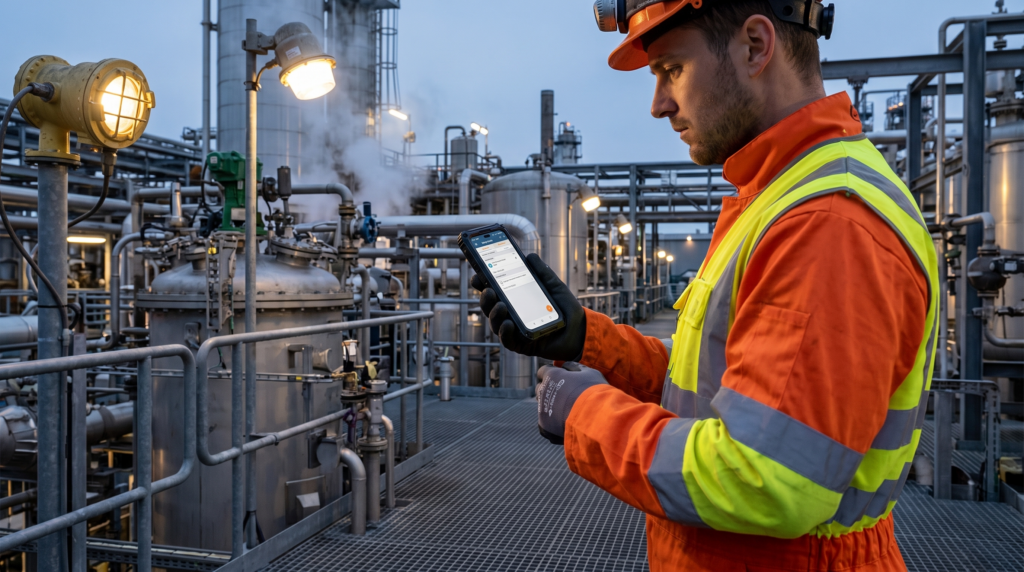
- RF shadows and dead zones: refineries and chemical plants are constructed from dense structural steel and miles of complex piping. These structures block cellular frequencies, creating massive “dead zones” where cloud connectivity is impossible.
- Offshore limitations: deepwater oil rigs often rely on satellite internet. This introduces extreme latency and bandwidth caps, making high-bandwidth cloud AI streaming sluggish or completely unresponsive.
- Security protocols: many facilities actively jam or restrict wireless transmissions around critical process units to prevent cyber-attacks or interference with sensitive telemetry.
When a cloud-dependent AI tool hits one of these barriers, the technician is left holding a useless piece of glass.
Bypassing the cloud with on-device edge AI
Edge AI solves the connectivity problem by moving the “brain” from a remote server directly onto the mobile device in the worker’s hand.
Optimized large language models (LLMs), such as the Gemma 4 edge variants (specifically the 2-billion and 4-billion parameter models), are specifically engineered for mobile silicon. Instead of demanding power-hungry server farms, these models execute inference cycles natively through the built-in neural processing units of modern smartphones, such as the Apple Neural Engine found in the latest A-series and Pro chips.
Once the AI model is downloaded onto the device, the smartphone can operate indefinitely in complete airplane mode. You can run generative text queries, analyze visual faults through the camera, and summarize audio reports completely offline.
To understand how site conditions should dictate your AI strategy, use our interactive comparison tool below:
Ironclad data privacy for regulated industries
For highly regulated sectors like pharmaceuticals and petrochemicals, data governance is just as critical as physical safety.
Standard cloud-based AI requires uploading proprietary process schematics, unreleased equipment photos, and sensitive operational queries to third-party vendor servers. This introduces massive compliance hurdles regarding corporate intellectual property (IP), GDPR, and ISO 27001 standards.
Edge AI eliminates this risk entirely:
- Zero data egress: your operational prompts, audio transcripts, and inspection photos never leave the local storage of the device.
- Audit-proof isolation: IT security teams can demonstrate to regulators that the AI system is entirely air-gapped from external networks during operation.
- Protected intellectual property: sensitive plant schematics and maintenance logs remain strictly within company-managed hardware boundaries.
Transforming field operations with offline AI workflows
Pairing edge AI with certified mobile hardware unlocks several high-value capabilities that previously required a desk and an internet connection.
Natural language procedure queries
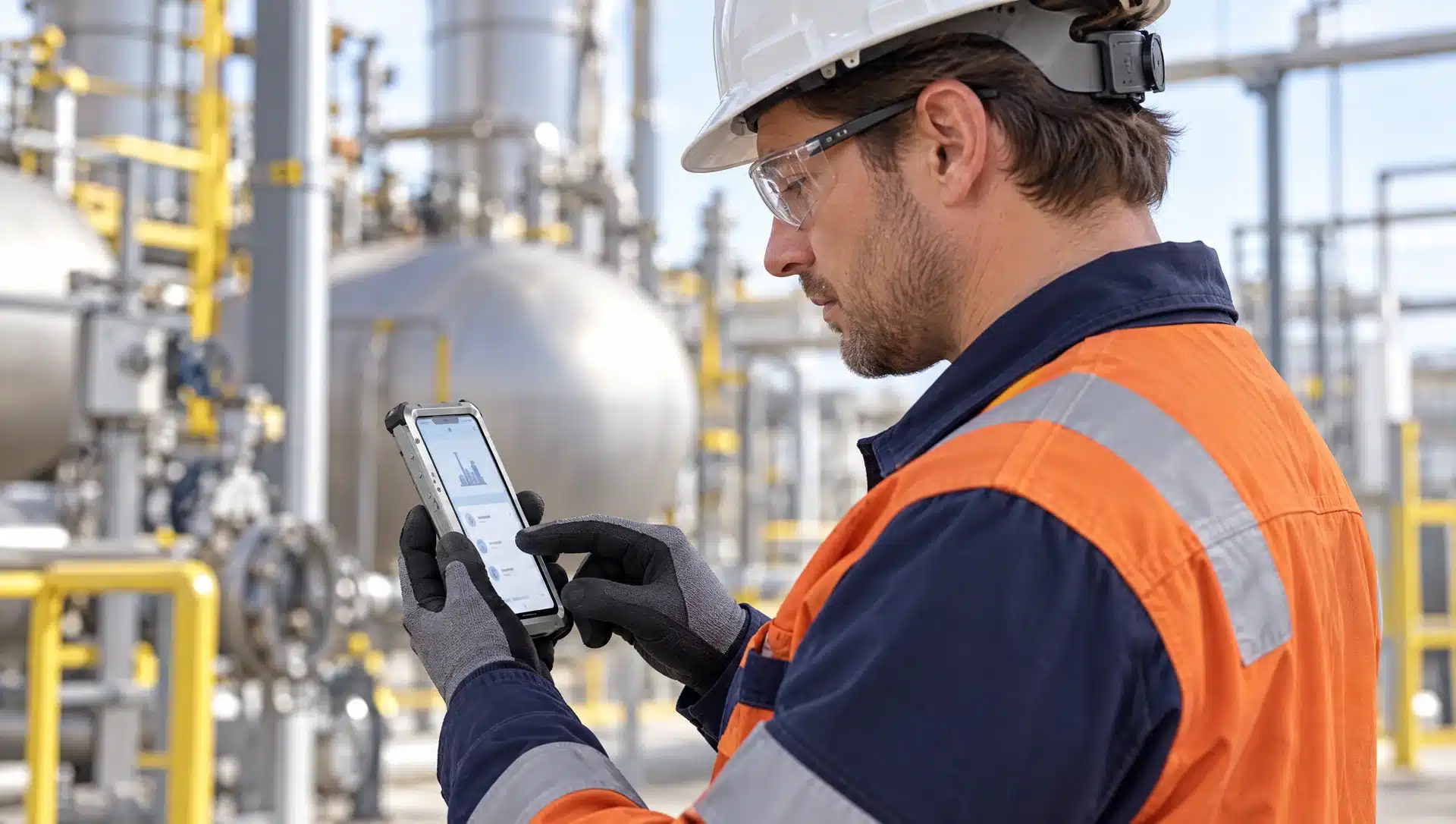
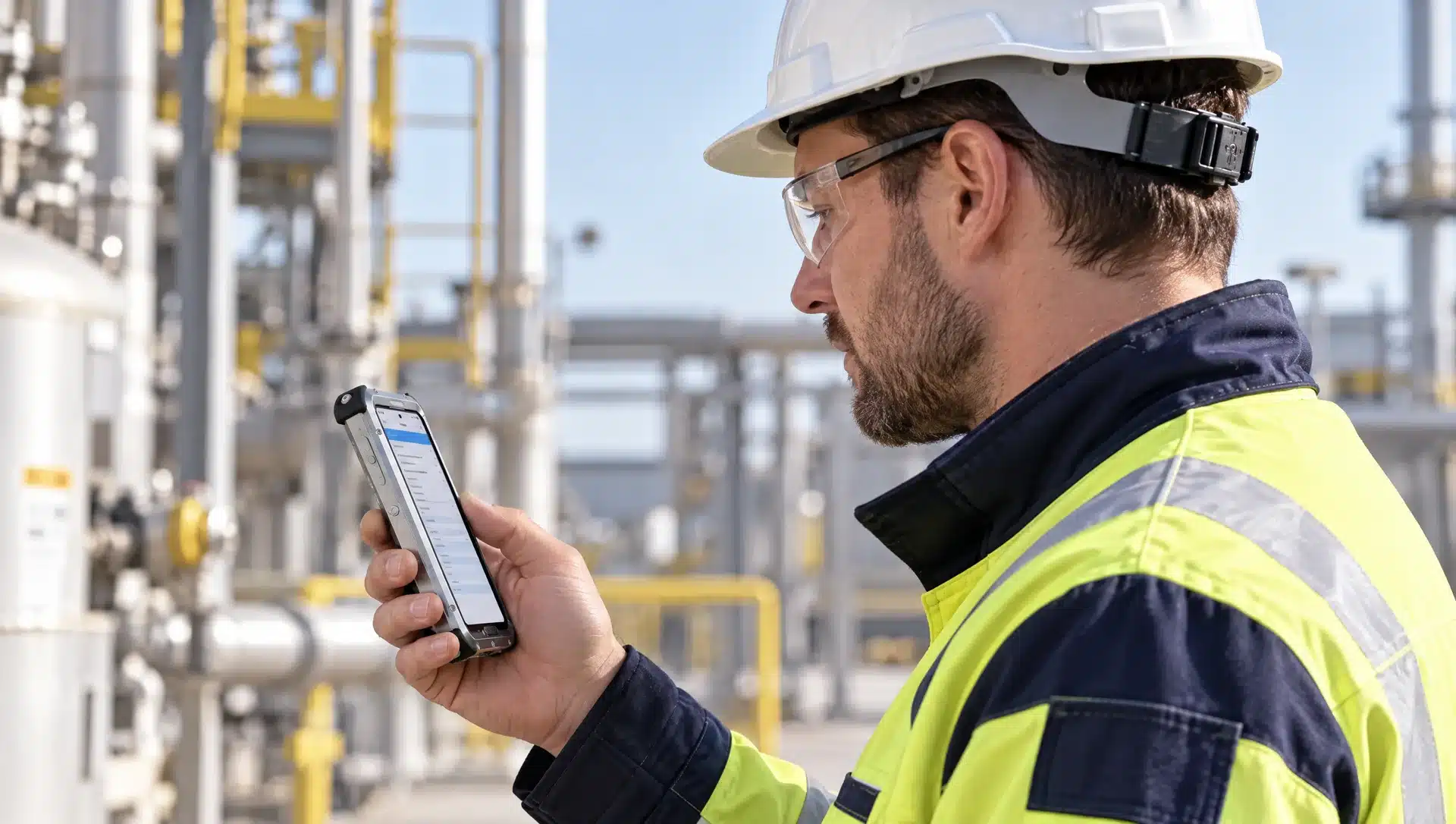
Imagine a technician standing next to a failing pump inside an ATEX Zone 1 area. They need to verify a complex, multi-step valve isolation sequence. Instead of scrolling through hundreds of pages in a PDF, they can query the local Gemma 4 model in plain English. The AI, loaded with the facility’s standard operating procedures (SOPs), instantly retrieves and outlines the exact isolation steps—all while entirely offline.
Visual fault recognition
An inspection engineer photographs an aging, heavily corroded valve body. Using local image recognition, the on-device AI identifies the specific asset tag, cross-references the visible physical degradation against a database of known defect signatures, and locally generates a recommended maintenance priority level.
Hands-free confined space reporting
When executing a confined space assessment inside a steel pressure vessel (where zero wireless signals penetrate), a safety inspector dictates their observations verbally into their smartphone. The local edge AI model processes the audio, structures the data, categorizes the safety risks, and summarizes the notes into an audit-ready inspection report before the inspector even climbs out of the vessel.
The hardware requirement: bringing Apple silicon into Zone 1
Running advanced edge AI models requires flagship mobile hardware equipped with high-performance neural processors and ample RAM (such as the iPhone 16 Pro Max or iPhone 17 Pro Max).
However, taking an uncertified commercial smartphone into a classified hazardous environment is highly illegal and incredibly dangerous. Standard devices are not sealed against explosive gases and can easily trigger a catastrophic ignition.
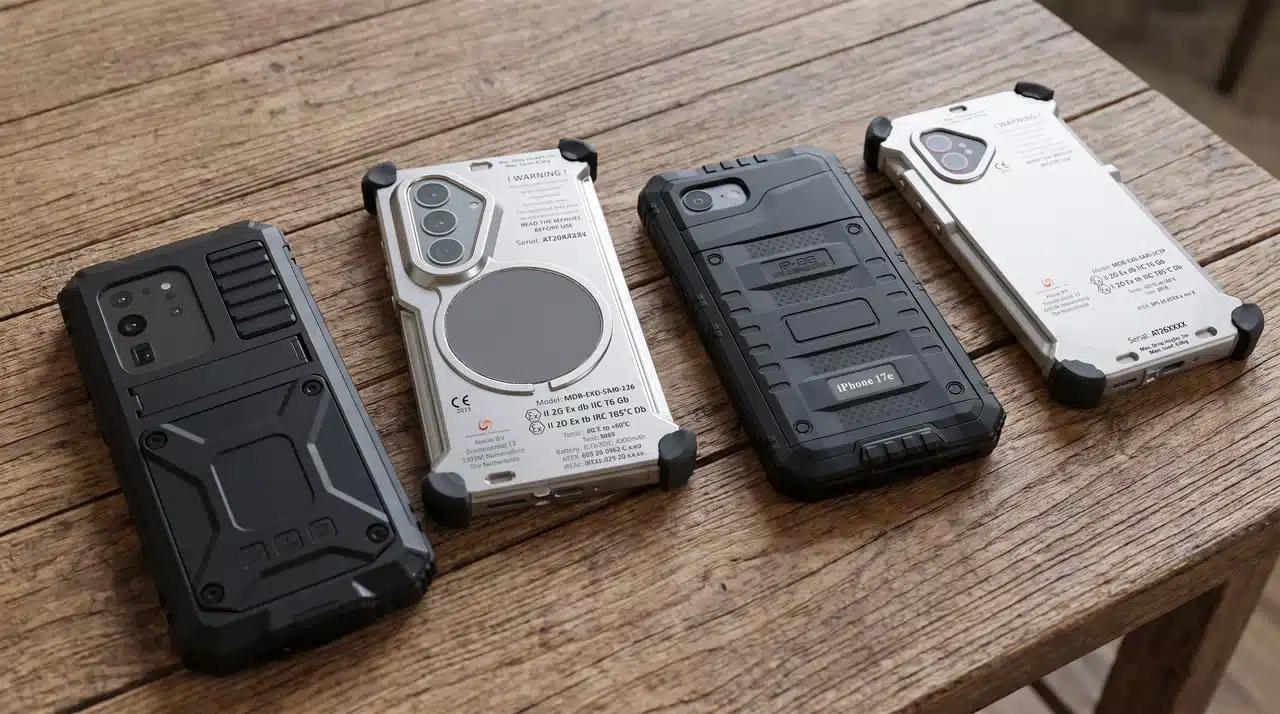
To safely execute edge AI workflows on the plant floor, these flagship devices must be housed inside certified Atexxo explosion-proof enclosures. Our precision-engineered cases are rigorously tested to contain internal electrical and thermal energy, meeting strict ATEX and IECEx Zone 1 and Zone 2 safety standards.
Crucially, our enclosures leave the camera optics, thermal dissipation pathways, and touch interfaces completely unobstructed. This ensures the smartphone’s internal neural engine can process heavy AI workloads continuously without overheating or lagging, giving your technicians the ultimate intelligent, offline tool.
Frequently asked questions
Does Google’s Gemma 4 actually run completely offline on a smartphone?
Yes. Once the Gemma 4 edge variant (such as the 2B or 4B model) is loaded onto the device via a local execution application, all data processing happens entirely on the local silicon. The device can function at full capacity in airplane mode with absolutely zero network activity or data transmission.
Which smartphone models offer optimal performance for on-device industrial AI?
While edge AI models can run on slightly older processors, optimal performance—especially for generative tasks and image recognition—is achieved on flagship models featuring advanced neural engines and 8GB or more of RAM. The iPhone 15 Pro, 16 Pro Max, and 17 Pro Max are highly recommended for these heavy workloads.
Can on-device AI replace human sign-offs in safety-critical operations?
No. Edge AI is designed to support, augment, and accelerate human decision-making by providing instantaneous access to local documentation and visual cross-references. Any AI-assisted workflow in a regulated, hazardous environment should serve as an advisory tool, with final authorization and critical decision-making remaining strictly in the hands of the trained human operator.